
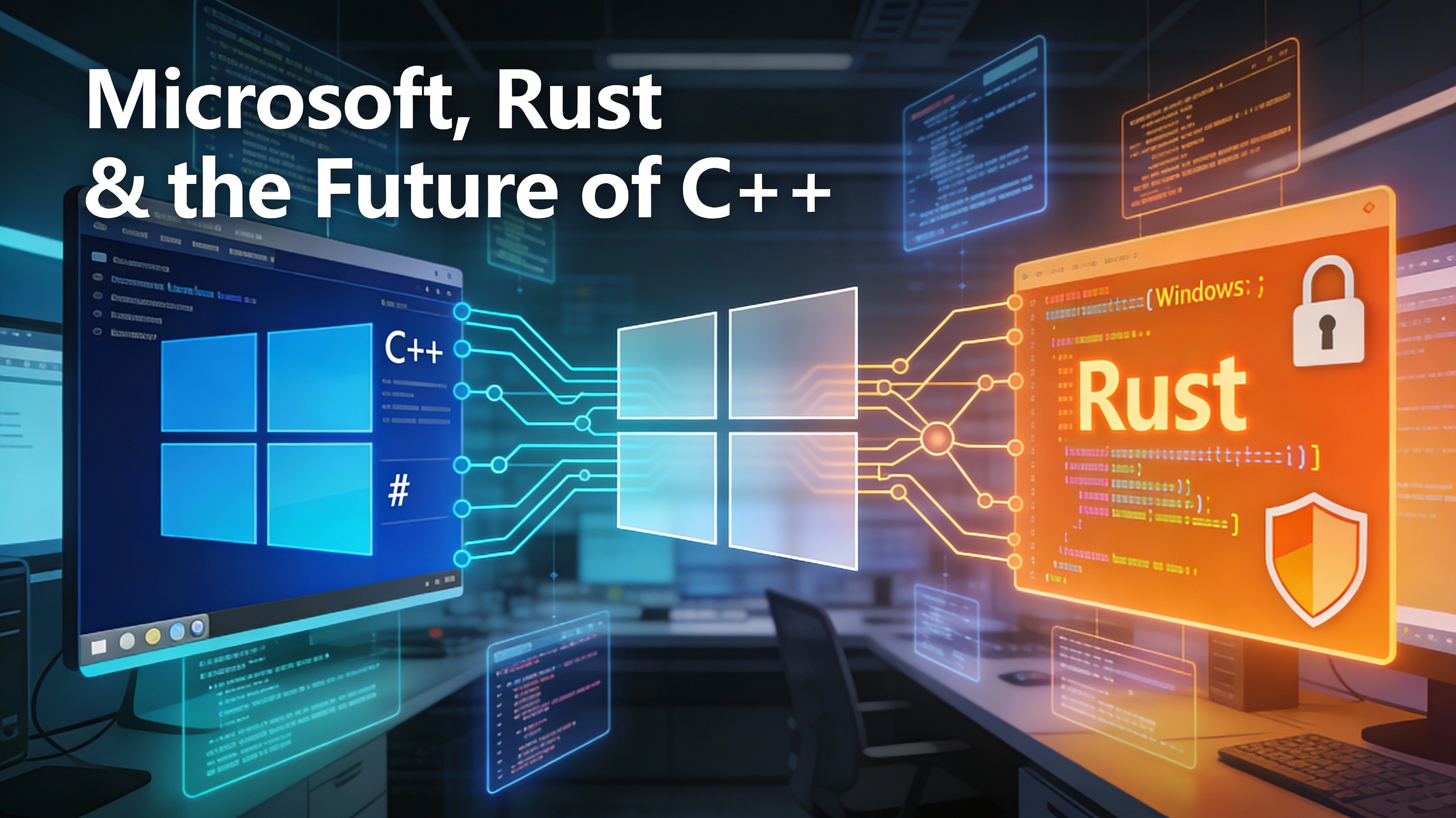
Microsoft is not ending C++ or C# or declaring them “end of life,” but it is aggressively expanding Rust for memory‑safe systems programming and exploring AI‑assisted migration of some C/C++ code. The viral “replace all C/C++ with Rust by 2030” line came from one engineer’s ambitious research goal, not an official company‑wide deprecation plan for C++, C#, or .NET.
Microsoft killing C++ and C# for Rust?
In late 2025, social media exploded with headlines claiming “Microsoft will replace all C and C++ with Rust by 2030,” sparking panic about the future of C++, C#, and the broader Windows ecosystem. Many developers quickly interpreted this as “C++ and C# are dead at Microsoft,” but the actual story is more nuanced and much less apocalyptic.
At the center of the drama is a LinkedIn post from Galen Hunt, a distinguished engineer in Microsoft’s CoreAI organization, who wrote that his “goal is to eliminate every line of C and C++ from Microsoft by 2030” using AI and Rust. The post described a research initiative and hiring pitch, not an official language end‑of‑life announcement for the entire company.
What Microsoft actually announced
Despite the viral headlines, Microsoft has not published any roadmap that deprecates or ends support for C++ or C#. Visual Studio and MSVC continue to receive defined lifecycle support, and .NET/.NET Core releases still follow the standard STS/LTS product support policy.
The concrete facts are:
- A CoreAI team is building infrastructure to translate large C/C++ systems to Rust with the help of AI agents, targeting “1 engineer, 1 month, 1 million lines of code”.
- The engineer clarified that this is a research‑driven project, not an official guarantee that Windows or all Microsoft products will be fully C/C++‑free by 2030.
- Microsoft’s public lifecycle pages show no “end of life” declaration for C# or .NET as languages/platforms; instead, individual .NET versions reach end of support on a normal cadence.
So the shift is real in terms of Rust adoption, but there is no evidence that Microsoft is shutting down C# or freezing C++ work across Windows, .NET, or developer tooling.
Why Microsoft is betting big on Rust
Even if C++ and C# are not being “killed,” Microsoft has clearly signaled that Rust is becoming a strategic language for new low‑level code, especially in security‑critical and infrastructure components. There are several reasons for this push.
- Microsoft has repeatedly reported that roughly 70% of its security vulnerabilities originate from memory‑unsafe code, primarily in C and C++.
- Rust offers C/C++‑class performance but enforces memory safety and thread safety at compile time through its ownership model, which significantly reduces entire classes of bugs.
- Azure and related projects have already shipped large Rust components, such as critical infrastructure pieces and driver stacks, showing that Rust can work at Microsoft scale.
This is not a sudden pivot; Microsoft Azure’s CTO has been publicly advocating for Rust as the default language for new system‑level projects since at least 2022, and Rust tooling for Windows drivers and other platform components continues to expand.
C++, C#, Rust: how they really compare
Microsoft’s trajectory looks less like “C++ and C# end of life” and more like a three‑tier strategy: C#/.NET for high‑level apps and services, C++ as legacy and performance‑critical workhorse, and Rust for new memory‑safe systems code.
Microsoft language roles in 2025+
| Aspect | C++ at Microsoft | C# / .NET at Microsoft | Rust at Microsoft |
|---|---|---|---|
| Primary domain | Legacy Windows, performance‑critical native components, some game & graphics code. | Application development, enterprise services, cloud apps, tools built on .NET. | New and migrated systems code, security‑critical infrastructure, drivers, some Azure components. |
| Current status | Massive existing codebase; no official deprecation; some parts targeted for gradual Rust migration. | Actively developed platform with regular STS/LTS releases; individual versions reach EoL but language is not. | “Strategic bet” for future low‑level work; growing adoption in Azure, Windows tooling, and new projects. |
| Key strengths | Raw performance, ecosystem maturity, decades of Windows integration. | Productivity, rich frameworks, GC safety, strong tooling in Visual Studio and cross‑platform .NET. | Memory and thread safety, modern tooling, performance comparable to C/C++. |
| Key concerns | High memory‑safety bug rate; difficult to harden at Microsoft’s scale. | Not suitable for all low‑level scenarios; GC and runtime constraints. | Ecosystem younger; migration and training costs; not all legacy code is easily convertible. |
This hybrid model mirrors what many large organizations are doing: keep mature C++ where it is, continue building business logic in C#/.NET, and introduce Rust for new security‑sensitive or performance‑critical infrastructure.
What this means for developers in 2026
For working developers and students, the key message is not “stop learning C++ and C#,” but “expect Rust to join them as a first‑class skill, especially around Microsoft ecosystems.” The company’s internal research into AI‑assisted C/C++‑to‑Rust migration only increases the long‑term relevance of Rust for those building low‑level or cloud infrastructure.
Practical takeaways:
- If you are a systems or game developer targeting Windows or Azure, knowing C++ plus Rust will position you well for both legacy maintenance and new greenfield work.
- If you mainly build business apps, APIs, or enterprise tools, C# and modern .NET are still safe investments with clear lifecycle support and ongoing investment from Microsoft.
- Keeping an eye on Microsoft’s driver‑in‑Rust projects, CoreAI migration tools, and Azure Rust stacks can help you anticipate where future hiring demand will rise.
Comments 0
No comments yet
Be the first to share your thoughts!
Leave a Comment