
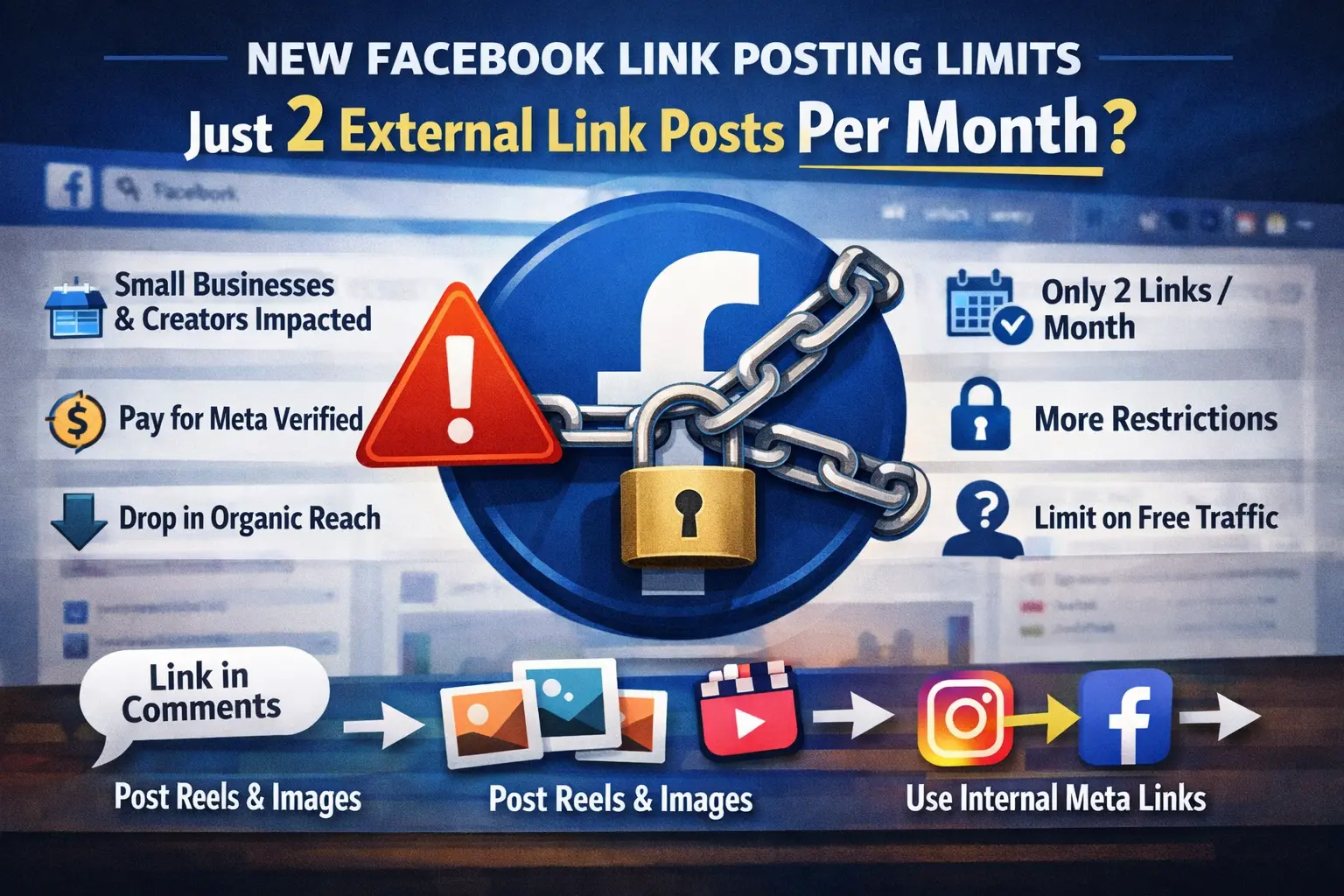
Facebook Tests Strict Link-Posting Limits for Pages and Professional Profiles
Facebook is currently testing a strict cap on external link posts for Professional Mode profiles and Facebook Pages. Under this experiment, most non–Meta Verified accounts are limited to just two external link posts per month, with higher limits available only through a paid Meta Verified subscription.
While Meta describes this as a limited test—not a fully rolled-out global policy—it already has major implications for creators, small businesses, affiliate marketers, and publishers that rely heavily on Facebook traffic.
What Facebook (Meta) Is Testing
Meta is experimenting with new restrictions on how often professional accounts can post external links.
In the test:
Professional Mode profiles and Facebook Pages are restricted to two organic link posts per month unless they subscribe to Meta Verified.
Meta says the goal is to evaluate the added value of higher link limits as part of its paid subscription offering.
The test primarily targets creators, brands, and small businesses using Facebook professionally.
Although Meta claims publishers are not officially included, many media-style Pages report receiving the same warning notifications.
This indicates the test may be broader in practice than Meta has publicly stated.
Exact Link-Posting Limits (So Far)
The precise limits vary slightly depending on the test group, showing that Meta is still A/B testing different thresholds.
The strictest version reported includes:
Two external link posts per month for non–Meta Verified accounts.
Notifications stating:
“Starting December 16, certain Facebook profiles without Meta Verified will be limited to sharing links in 2 organic posts per month.”To exceed the cap, users must subscribe to Meta Verified, which costs around $14.99/month in the U.S. (pricing varies by region).
Unused link posts do not roll over to the next month.
Some users report alternative tests, such as two external links per week, confirming Meta is still refining the model.
What Still Works Under the New Limit
The restriction applies only to posts where the main content includes an external URL that sends users off Facebook.
You can still:
Post images, videos, text updates, and Reels without restriction.
Place external links in the comments under your own posts (currently not limited).
Share affiliate links or links that stay within Meta’s ecosystem (Facebook, Instagram, WhatsApp).
Cross-link to Facebook Shops, Events, or internal Meta content without using your link quota.
This setup clearly encourages users to keep engagement inside Meta’s platforms—or pay to send traffic elsewhere.
Why Meta Is Doing This
Meta frames the test as a way to improve its subscription offering, but the broader business motivations are clear.
Key Drivers Behind the Test
Monetization
By limiting organic link distribution and tying higher limits to Meta Verified, Meta creates a new recurring revenue stream aimed at creators and businesses.
Platform Retention
External links pull users off Facebook, reducing time spent on the platform and ad impressions.
Fewer outbound links mean more engagement stays inside Meta’s ecosystem.
Spam and Quality Control
Meta claims link limits help reduce spam and low-quality promotional posts.
Critics argue the policy disproportionately affects legitimate small businesses and creators, not just spammers.
Industry analysts note that this effectively paywalls organic reach for external URLs, increasing pressure on smaller players already facing declining Facebook reach.
Impact on Professional Accounts and Facebook Pages
For many users, this test could be disruptive.
Most Affected Groups
Small businesses and local brands that rely on Facebook to drive traffic to websites, booking systems, or online stores.
Content creators and affiliate marketers who regularly share blog posts, YouTube videos, or affiliate offers.
Publishers and media outlets, especially those operating Pages in Professional Mode, despite Meta’s claims they’re not included.
Practical Consequences
Expect reduced organic traffic from Facebook if you previously posted links frequently.
Creators and marketers are already adapting by:
Posting native content (carousels, Reels, text posts).
Placing external links in the first comment instead of the main post.
Using more internal Meta links to stay within the rules.
What This Means Going Forward
Although this is still a test, it signals a clear strategic direction: Meta wants to monetize outbound traffic and keep users inside its platforms.
If rolled out globally, this policy could permanently change how businesses and creators use Facebook—making paid subscriptions or alternative distribution strategies increasingly necessary.
Comments 0
No comments yet
Be the first to share your thoughts!
Leave a Comment