
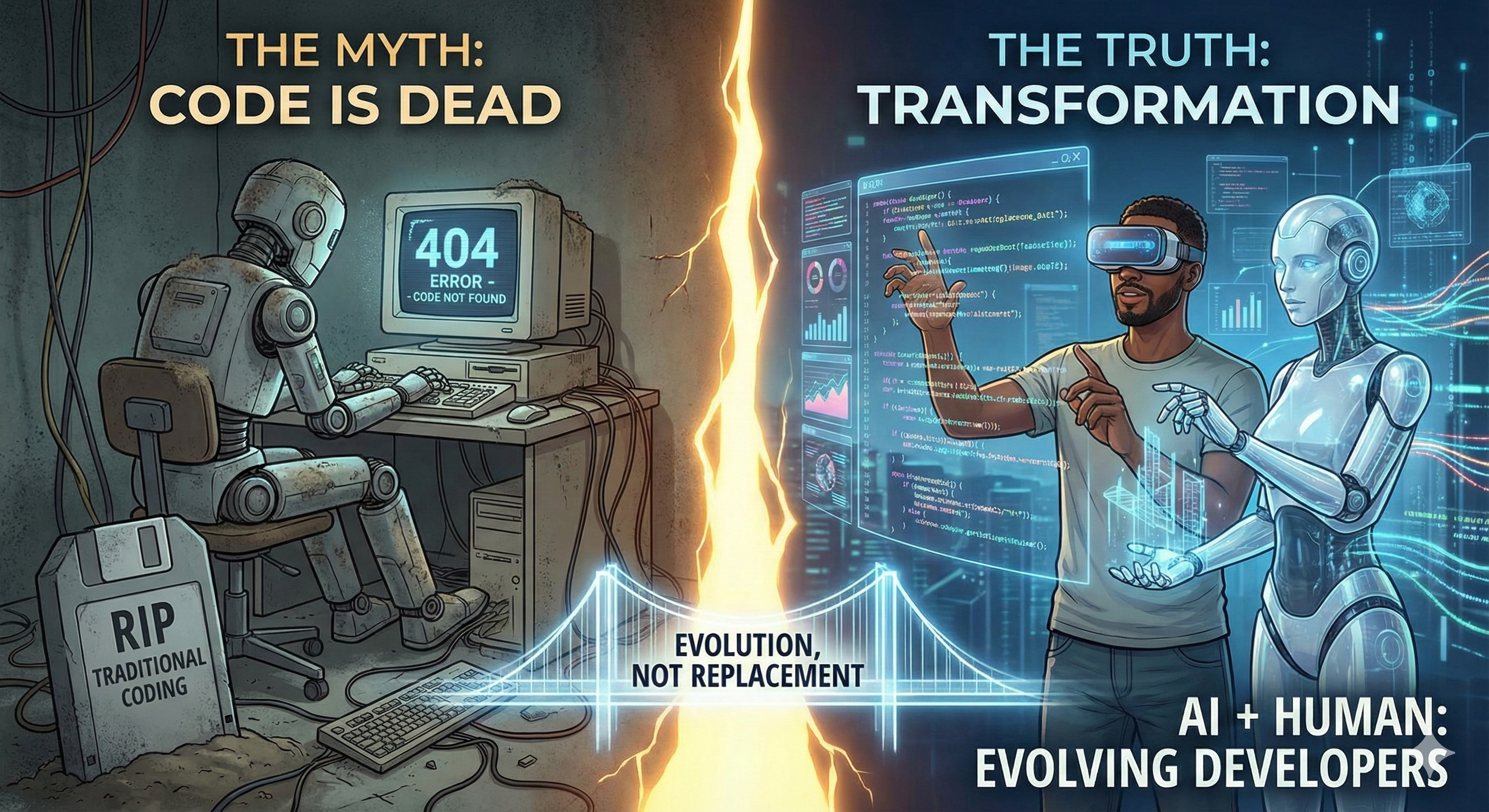
Is Code Dead? The Truth About AI and the Future of Developers
The dramatic proclamation that "code is dead" has echoed across tech forums and social media since Mark Zuckerberg predicted that AI would replace mid level engineers by 2025. Major tech leaders are making bold statements: Microsoft's CTO Kevin Scott forecasts that 95% of code will be AI-generated by 2030, while Zuckerberg himself estimates that half of Meta's development will be done by AI within a year. Yet the reality is far more nuanced than these headlines suggest — AI isn't killing code or developers, but fundamentally transforming how software development works.
The AI Coding Revolution in Numbers
The statistics paint a picture of rapid transformation rather than replacement. GitHub Copilot, the market leader with 42% share among paid AI coding tools, now serves over 15 million users with 90% Fortune 100 adoption. Developers using AI coding assistants report 51% faster coding speed and 88% code retention rates, meaning they keep nearly all AI generated suggestions. A remarkable 92% of developers now use AI coding tools in professional and personal settings, according to GitHub surveys. Microsoft and Google report that 20-30% of code in their internal repositories is already AI generated, with some projects entirely written by software.
What's Actually Changing
AI is reshaping the entire software development lifecycle beyond just code generation. Modern tools like GitHub Copilot, Cursor (which commands 18% market share), and autonomous agents like AWS Kiro now handle tasks from design specifications to testing, debugging, and documentation. The progression has moved from predictive text completion five years ago to "vibe coding," where developers start with natural language prompts and AI makes large-scale changes across multiple files. The fourth phase — autonomous agents — now performs large scale tasks like code reviews, migration projects, and deployment pipelines with minimal human supervision.
The Jobs Reality Check
Entry level positions face the most significant impact from AI automation. A Stanford Digital Economy Study found that employment for software developers aged 22-25 declined nearly 20% by July 2025. AI can now handle boilerplate tasks once assigned to junior developers, reducing internships and entry-level positions. However, the US Bureau of Labor Statistics projects that while routine programming jobs will drop from 139,000 to 126,000 over the next decade, highly skilled developers — particularly software developers, data scientists, and machine learning engineers — will remain in high demand. The demand for AI related roles has more than doubled over the past three years.
The Developer Skillset Evolution
The role of developer isn't disappearing it's evolving into something different. As IBM Fellow Kyle Charlet explains, AI tools remove mundane tasks so developers can focus on innovation, system architecture, and winning in the market. Future developers need to become AI-literate, capable of evaluating, debugging, and fine-tuning AI-generated code rather than writing every line from scratch. The most in-demand skills now combine traditional software engineering with machine learning expertise, product ownership capabilities, and the ability to work alongside autonomous AI agents. Developers who adapt by using AI as a co-pilot rather than viewing it as competition will thrive in this new landscape.
Comments 0
No comments yet
Be the first to share your thoughts!
Leave a Comment