
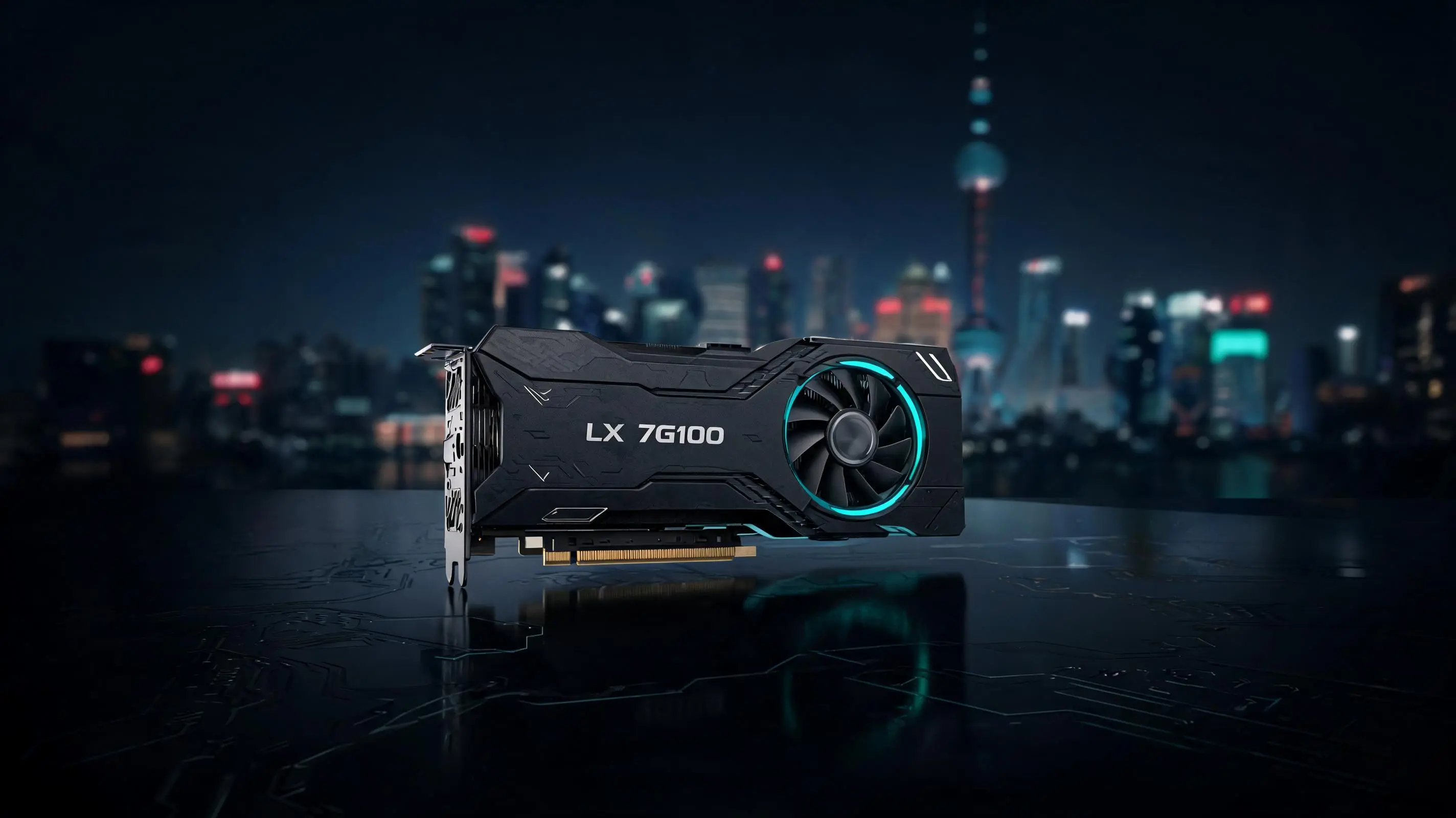
Lisuan Tech LX 7G100: China's New Domestic Gaming GPU
Lisuan Tech's LX 7G100 is a newly released Chinese gaming graphics card based on the company's self-developed TrueGPU architecture, positioned broadly around GeForce RTX 4060-class performance but with notable gaps and trade-offs depending on workload and game engine. It is currently sold only in China, where initial batches reportedly sold out quickly, signaling strong domestic interest in a homegrown discrete GPU that can run modern AAA titles with WHQL-certified Windows drivers.
Company and Architecture Background
Lisuan Tech (礪算科技) is a Shanghai-based GPU startup focused on building a fully domestic graphics ecosystem for gaming, cloud, and AI workloads, using an in-house TrueGPU "Tiantu" architecture from ISA up through the software stack. The 7G100 series chips, including the LX 7G100's 7G106 die, are manufactured on TSMC's 6nm process and are marketed as China's first fully self-designed gaming-capable DirectX 12 GPUs that can seriously target Nvidia and AMD mid-range products.
TrueGPU emphasizes independent IP with no reliance on third-party GPU core IP like Imagination, coupled with a proprietary software stack that includes graphics drivers, runtime libraries and tools tuned for both games and AI workloads. On the data-center side, 7G100-series GPUs are pitched for cloud gaming, digital twin/simulation, and intelligent cockpit scenarios, while the LX 7G100 add-in card aims at desktop gamers as a flagship consumer implementation.
Core Specifications of LX 7G100
Hardware Configuration
The LX 7G100 features the following key specifications:
- 6nm 7G106 GPU die, part of the 7G100 series
- 12GB of GDDR6 VRAM
- PCI Express 4.0 x16 interface
- Board power up to around 225W, powered via a single 8-pin connector
- 192 texture mapping units (TMUs) and 96 render output units (ROPs)
- Four DisplayPort 1.4a outputs with support for up to 8K60 HDR with DSC, plus HEVC 8K decode and 8K30 encode
These specs clearly place the LX 7G100 in the mainstream-to-upper-midrange segment, comparable on paper to Nvidia's 1080p–1440p gaming cards rather than high-end 4K GPUs.
API and Feature Support
Lisuan promotes fairly complete modern API coverage for LX 7G100:
- DirectX 12 (including Agility SDK) support, making it China's first fully domestic DirectX 12 gaming GPU certified for Windows
- Vulkan 1.3, OpenGL 4.6, and OpenCL 3.0 support
- Microsoft WHQL-certified drivers, making Lisuan the fourth GPU vendor after Nvidia, AMD, and Intel to obtain this certification
- Support for FreeSync, HDR, and 8K60 output over DisplayPort 1.4a
The card also exposes Lisuan's own NRSS upscaling technology, conceptually similar to DLSS/FSR, which is exclusive to the LX 7G100 within the company's lineup and is used to boost frame rates in supported titles.
Performance Positioning and Benchmarks
Official Positioning versus RTX 4060
Lisuan and many media outlets frame the LX 7G100 as targeting GeForce RTX 4060-class performance, at least in terms of theoretical capability. Early marketing around the underlying 7G100 chips claimed that in certain workloads the GPU could match or even exceed RTX 4060 performance, particularly in controlled demos and AI or simulation scenarios.
For gaming, however, independent benchmarks paint a more modest picture: the LX 7G100 typically lands somewhat below RTX 4060 levels, especially when ray tracing or more mature driver optimization for Nvidia is a factor.
Synthetic Benchmarks
Published numbers for the LX 7G100 include approximately 26,800 points in 3DMark Fire Strike and 2,268 points in the Steel Nomad test. These scores roughly align the card with mainstream 1080p-oriented GPUs and place it behind an RTX 4060, particularly in newer synthetic workloads where Nvidia has strong architectural advantages.
Gaming Benchmarks and Real-World Performance
Independent gaming tests indicate that the LX 7G100 can run modern AAA titles such as Black Myth: Wukong, Cyberpunk 2077, Forza Horizon 5, and Horizon Forbidden West at playable frame rates, confirming that this is a genuinely viable gaming GPU rather than a proof-of-concept part. Performance tends to track somewhere below RTX 4060, often closer to older Nvidia mid-range parts like the RTX 3060 in many rasterized titles, while falling further behind when advanced features like ray tracing are enabled or when games rely heavily on vendor-specific optimizations.
Reviewers also note that while the LX 7G100 avoids the catastrophic driver issues that plagued earlier Chinese GPUs, its driver maturity and game-specific optimization still lag far behind Nvidia and AMD, leading to inconsistent frame pacing or reduced performance in certain engines.
Software Ecosystem and Drivers
WHQL Certification and Windows Support
One of the most significant milestones for the LX 7G100 is its Microsoft WHQL driver certification, making Lisuan the first Chinese GPU vendor to achieve official Windows driver certification for a gaming-class GPU. This directly addresses a long-standing issue for domestic GPUs, which historically suffered from poor Windows integration and limited API support, restricting them to niche or embedded markets.
WHQL certification ensures that LX 7G100 drivers integrate cleanly into modern Windows builds with signed, automatically distributed packages, improving both installation experience and compatibility with common game launchers and anti-cheat systems. For domestic Chinese OEMs and system integrators, this certification makes it feasible to ship prebuilt gaming PCs using Lisuan GPUs without resorting to workarounds or unofficial drivers.
Game Compatibility and Optimization Status
Lisuan claims that the LX 7G100 already supports about one hundred games with validated compatibility at launch, focusing on popular domestic and global AAA titles. Early reviewers confirm that mainstream games such as Black Myth: Wukong and other large-scale Unreal Engine or proprietary-engine titles do run and are playable, though performance tuning varies from title to title.
Because this is a brand-new architecture and driver stack, the ecosystem still lacks the deep per-game optimization, extensive shader caching, and long tail of bug fixes that Nvidia and AMD have built up over many years. Gamers can therefore expect occasional glitches, inconsistent frame times, or missing optimizations in less popular or newly released games until Lisuan's driver team and developer relations catch up.
Market Reception and Availability in China
Launch, Sales, and Availability
The LX 7G100 Founders Edition was officially launched in late May 2026 as Lisuan's first consumer gaming GPU card in China, following earlier sampling and professional-market deployments of the 7G100 chips. At launch, Lisuan initially offered a limited Founders Edition run of around one thousand cards in China, with subsequent larger pre-sale batches.
Reports indicate that a pre-sale batch of about 30,000 LX 7G100 cards sold out in forty-eight hours, with the next shipment scheduled for mid-June and sales currently limited to the Chinese domestic market. This suggests strong pent-up demand among Chinese enthusiasts and national-tech supporters for a homegrown alternative to Nvidia and AMD GPUs, even if performance-per-dollar is not yet globally competitive.
Pricing and Value Proposition
Pricing disclosures vary by outlet, but estimates put the launch price of the LX 7G100 around the equivalent of 480 US dollars, placing it significantly above typical RTX 4060 street prices in many markets. Some reviewers describe the pricing as "exorbitant" for a first-generation GPU that often underperforms an RTX 4060, emphasizing that early adopters are largely paying a premium to support domestic technology or to experiment with a novel platform.
From a value perspective, the card's appeal is strongest for buyers in mainland China facing elevated or uncertain availability and pricing for imported Nvidia/AMD cards, enthusiasts interested in backing Chinese semiconductor self-sufficiency, and OEMs or system builders seeking to offer "all-domestic" configurations for political, regulatory, or branding reasons.
Strategic Significance for China's GPU Ecosystem
Domestic Self-Sufficiency and Sanctions Context
Lisuan's 7G100 series and the LX 7G100 card arrive in the broader context of China's efforts to build domestic alternatives to US-controlled GPU technologies amid export controls and sanctions that restrict access to advanced Nvidia and AMD accelerators. By designing its own GPU architecture and software stack, Lisuan helps reduce dependence on foreign IP and builds local expertise in both graphics and compute acceleration.
While the LX 7G100 is marketed primarily as a gaming card, the underlying TrueGPU architecture and 7G100 chips are also pitched for AI inference, simulation, digital twin workloads, and cloud gaming, aligning with China's strategic push for self-reliant data-center and AI infrastructure.
Ecosystem Building and Developer Support
The long-term viability of Lisuan's GPUs hinges on building out tools, SDKs, and developer support comparable to Nvidia's CUDA and AMD's ROCm for compute and to GameWorks-style libraries for graphics. Early coverage mentions intelligent multi-tasking, SR-IOV virtualization, and proprietary upscaling technologies as differentiators, but these will only matter if they are exposed through robust APIs and widely adopted by game and engine developers.
In the short term, Lisuan's priority appears to be scaling production, stabilizing drivers, and deepening integration with key Chinese game studios so that flagship domestic titles run well on LX 7G100 and its successors. Success here would create a virtuous cycle of better performance, more users, and stronger incentives for developers to support the platform.
Performance Comparison: LX 7G100 vs RTX 4060
| Aspect | Lisuan LX 7G100 | Nvidia GeForce RTX 4060 |
|---|---|---|
| Process | 6nm (TSMC) TrueGPU 7G106 | 5nm class (TSMC 4N) Ada Lovelace |
| VRAM | 12GB GDDR6 | 8GB GDDR6 |
| Board Power | ~225W single 8-pin | ~115W |
| APIs | DX12, Vulkan 1.3, OpenGL 4.6, OpenCL 3.0 | DX12 Ultimate, Vulkan, OpenGL, CUDA |
| Driver Maturity | First-gen WHQL, ~100 supported games | Very mature, extensive per-game tuning |
| Gaming Performance | Below RTX 4060 average; closer to RTX 3060 | Baseline in this class; generally faster |
| Unique Features | NRSS upscaling, domestic architecture | DLSS 3.x, Frame Generation, Reflex |
Constraints, Limitations, and Future Outlook
The LX 7G100's main limitations are its relatively high power consumption for its performance class, first-generation driver ecosystem, inconsistent per-game optimization, and launch pricing that often exceeds better-performing, better-supported alternatives from Nvidia and AMD in markets where those are easily available. It also lacks the extensive ray-tracing, upscaling, and creator-tool ecosystems that Nvidia and AMD have built around their GPUs.
Despite these drawbacks, the card marks a genuine inflection point: it proves that a Chinese startup can bring a self-designed 6nm gaming GPU with WHQL-certified DirectX 12 drivers to market, run modern AAA games, and achieve tens of thousands of pre-orders in its domestic market. If Lisuan can iterate quickly on performance, power efficiency, and driver quality—while expanding developer support—future 7G-series or successor GPUs could become increasingly competitive not only in China but eventually in global mid-range segments.
For now, LX 7G100 is best seen as a technologically significant first generation: a proof that China's domestic GPU ambitions have reached the point of viable, if not yet best-in-class, gaming hardware.
Comments 1
Leave a Comment