
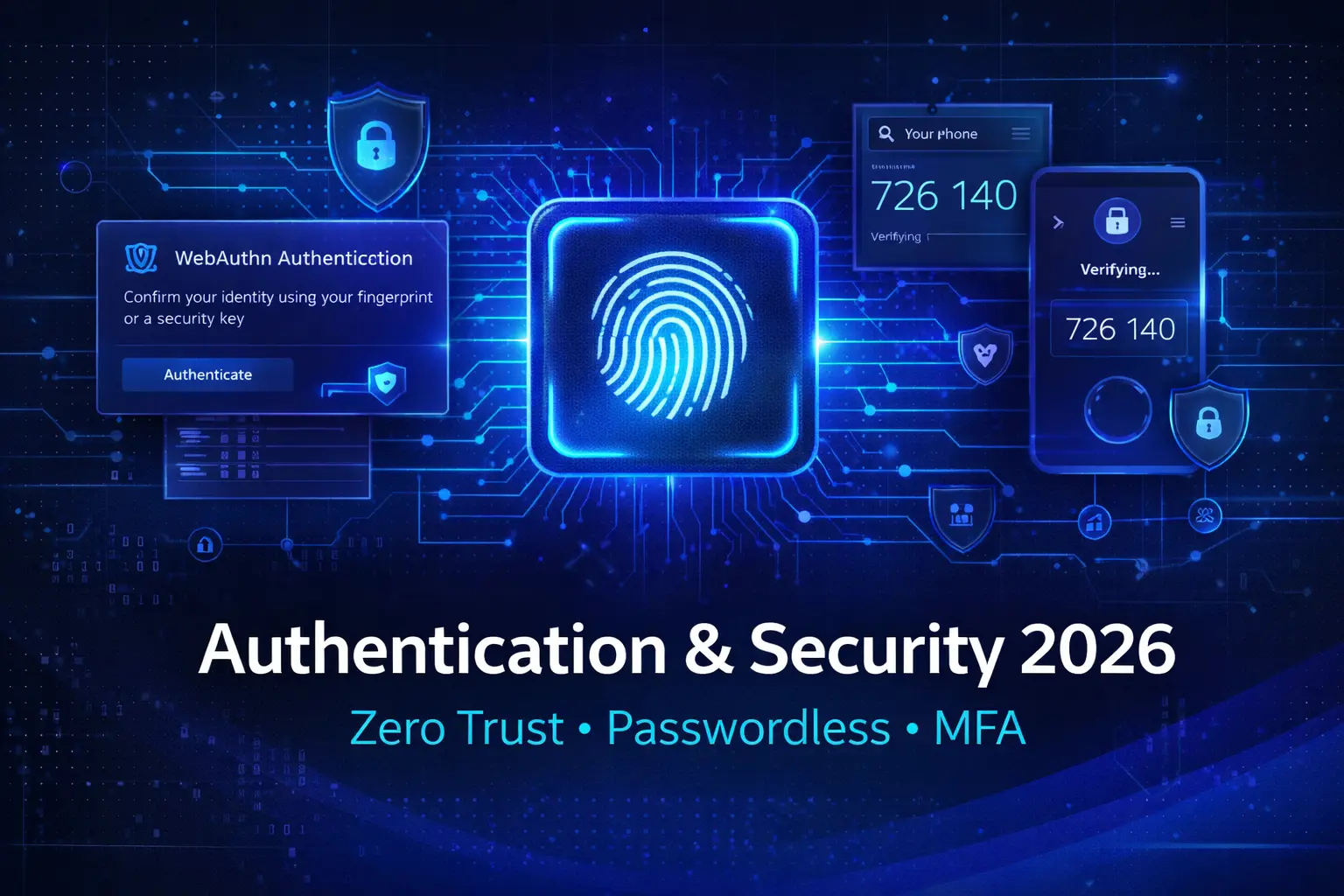
Authentication & Security: A Comprehensive Guide for 2026
Authentication and security have evolved dramatically as cyber threats grow more sophisticated and organizations shift toward zero-trust architectures. Traditional password-based systems are no longer sufficient, with modern security frameworks requiring multi-layered approaches that combine passwordless authentication, multi-factor verification, and continuous monitoring.
The End of Password-Only Authentication
Passwords remain the weakest link in cybersecurity, vulnerable to human error, credential reuse, social engineering, database leaks, brute-force attacks, and phishing. Even strong password policies cannot prevent these fundamental vulnerabilities. By 2026, secure systems must support passwordless authentication, WebAuthn and passkeys, multi-factor authentication (MFA), risk-based login validation, and device verification.
Password fatigue and the increasing sophistication of phishing attacks are driving the industry-wide shift toward passwordless login methods. Passkey-first approaches are now recommended for new implementations, while existing authentication flows should begin planning migration strategies.
Passwordless Authentication Methods
Biometric Authentication
Biometric authentication stands at the forefront of passwordless technologies, utilizing unique physical or behavioral characteristics to verify user identity. By 2025, 45% of MFA implementations included biometric factors such as fingerprint or facial recognition, enhancing both security and convenience. Identity-Bound Biometrics (IBB) provides the highest levels of integrity and security by establishing trust in a person's biometric identity rather than the device itself.
WebAuthn and Passkeys
WebAuthn and passkeys have become standard technologies for passwordless authentication, offering FIDO2-compliant protocols that eliminate traditional password vulnerabilities. These methods provide seamless user experiences while maintaining enterprise-grade security, making them ideal for SaaS, e-commerce, fintech, health tech, and legal tech applications.
One-Time Passwords (OTPs)
OTPs generate unique codes for each login attempt or transaction, operating on the principle of "what you receive" rather than "what you know". Access is granted only for a short time window before the password becomes invalid, ensuring dynamic security.
Multi-Factor Authentication Best Practices
Multi-factor authentication reduces unauthorized access by over 90%. Effective MFA implementations in 2026 incorporate several key practices:
- TOTP apps like Google Authenticator for time-based one-time passwords
- Push notifications to trusted mobile devices for authentication approval
- WebAuthn as a second factor combining biometrics with device verification
- Adaptive and risk-based MFA that evaluates geolocation, IP reputation, time of access, and device trust to determine authentication requirements
By 2026, 40% of MFA solutions use AI-driven behavioral analytics to detect anomalies in user behavior and secure systems from fraudulent access attempts. This allows organizations to trust low-risk logins while automatically triggering step-up authentication when risk indicators are detected.
Zero Trust Architecture
Zero trust is a security framework operating on the principle of "never trust, always verify," requiring strict identity verification for every user and device requesting access to resources regardless of location. According to recent research, 81% of organizations plan to adopt zero trust by 2026 as VPNs become vulnerable to AI-fueled cyber attacks.
Core Principles of Zero Trust
Zero trust architectures are built on five fundamental principles:
- Verify every user and device through MFA, biometrics, device posture checks, and real-time risk signals
- Apply least privilege access by granting users and systems only the minimum access needed to perform their tasks
- Segment the network into small, isolated zones to prevent lateral movement if attackers break in
- Continuously monitor behavior by watching user actions, device behavior, and network patterns
- Enforce policies dynamically based on context such as location, device health, user role, time, and behavioral patterns
Unlike one-time authentication, zero trust validates identities and permissions throughout the session using continuous monitoring, behavior analytics, and contextual risk scoring.
Single Sign-On (SSO) Security
Single sign-on implementations require careful attention to security best practices to reduce access risk. Organizations should automate credential rotation on a defined schedule, with many rotating signing certificates quarterly and OAuth secrets more frequently. Operational realities often push manual key rotation down the priority list, leaving credentials in place far longer than intended and increasing the damage caused by undetected compromise.
OAuth scopes and SAML attributes define what data applications can access, but default configurations often grant excessive permissions for convenience. Enforcing least privilege across connected applications helps contain identity-based incidents by limiting the blast radius when an account is compromised.
Authentication Protocols: SAML vs OAuth
SAML and OAuth serve different purposes in modern authentication architectures:
- SAML focuses on authentication, authorization, and SSO using XML-based messages with browser-based flows and digital certificates
- OAuth handles authorization and delegation using JSON-based messages with server-to-server flows and access tokens
- Data format: SAML uses XML while OAuth uses JSON
- Mobile suitability: OAuth is better suited for mobile due to lightweight JSON and HTTP
- Security model: SAML relies on digital certificates and public/private keys, while OAuth uses access tokens and refresh tokens
SAML and OAuth can be used together to provide comprehensive authentication and authorization mechanisms. By using SAML for SSO and OAuth for authorization, organizations improve security by reducing login credentials while allowing users to delegate access to resources without sharing credentials.
Identity-Based Attack Threats
Identity-based attacks target user credentials such as usernames, passwords, and authentication tokens to gain unauthorized access. These attacks have increased due to adversarial AI, cloud-based identity providers, and widespread SaaS adoption, with 5 of the top 10 MITRE ATT&CK tactics being identity-based.
Common Authentication Attacks
Brute-force attacks systematically guess passwords using automated tools until the correct one is found. Organizations should enforce strong password policies, implement account lockouts or increasing delays after failed attempts, and add CAPTCHA challenges to prevent automation.
Credential stuffing exploits users who reuse passwords by using previously stolen credentials from data breaches to access multiple accounts. Attackers leverage stolen credentials or purchase breached credentials via the dark web, then use botnets to attempt simultaneous logins across unrelated accounts. Mitigation requires enforcing unique passwords across services, using MFA, and monitoring for unusual login patterns.
Advanced Persistent Threats (APTs) are sophisticated, targeted attacks aimed at high-value targets over extended periods. They exploit authentication vulnerabilities such as stolen credentials or session tokens to gain persistent access, combining multiple attack techniques like phishing and session hijacking to bypass defenses.
Key Recommendations for 2026
Authentication systems in 2026 require a multi-layered, zero-trust approach integrating identity verification, device intelligence, encryption, rate limiting, and continuous monitoring. Organizations building new systems should make them passkey-first, while those maintaining existing flows should plan migration strategies.
Great security with poor user experience renders security measures ineffective. Organizations must test authentication flows with real users, measure friction points, and iterate relentlessly to balance security with usability. Authentication systems should support risk-based, adaptive flows rather than static "you're in or you're out" models.
Real security comes from a layered, proactive approach that anticipates modern attack patterns and strengthens user identity verification at every stage. As AI agents and digital identities reshape the authentication landscape, organizations must understand emerging patterns to remain future-ready.
Comments 0
No comments yet
Be the first to share your thoughts!
Leave a Comment